You generated an image you love. You want to put it on a product, a book cover, a client project, a poster for sale. So the practical question lands fast: who actually owns this thing? You, the app that made it, or — unsettlingly — nobody at all?
The honest answer is that “ownership” of an AI image is really three separate questions wearing one coat. Untangle them and the whole thing gets a lot clearer. No law degree required.
The short answer
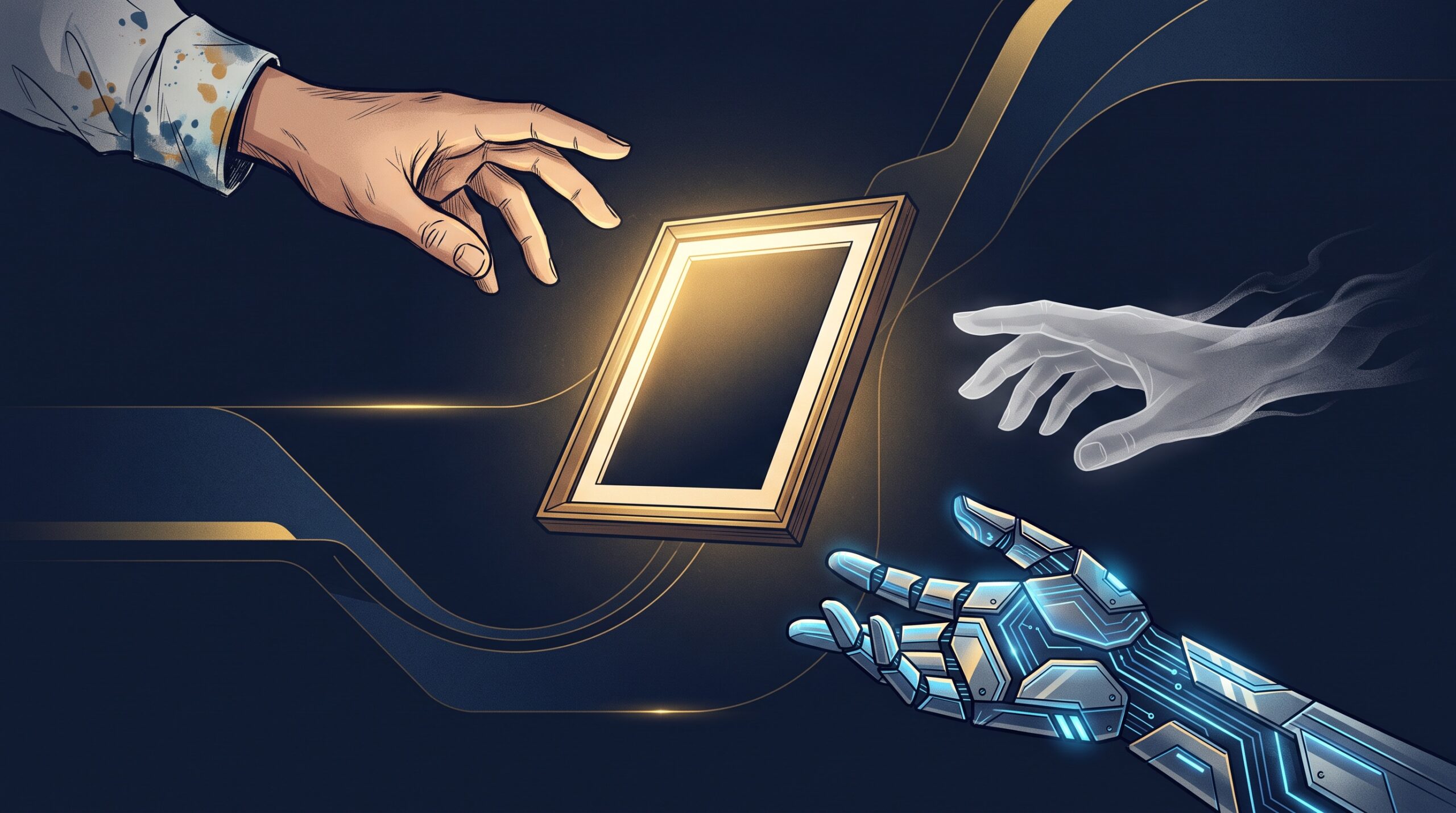
For a purely AI-generated image — you typed a prompt, the model produced a picture, you accepted it — no one owns a copyright in it. Not you, not the company that built the tool. In the United States, copyright requires a human author, and a machine’s output on its own doesn’t qualify. That doesn’t mean you can’t use the image; it means no one holds the exclusive right to stop others from using it.
Track the cases yourself
Every current AI-copyright ruling — and the ones still being fought — lives in our AI Copyright Ruling Tracker. Filter by your creator type to see, in plain language, how each case affects your rights.
Once you add real human creativity on top, you start to own the parts that came from you. And separately from copyright, the app’s terms of service decide what you’re contractually allowed to do with the picture. Those are different rights, and people constantly confuse them.
Question 1: Do you own the copyright?
Copyright is the big one — it’s the right to stop other people from copying, selling, or reusing your work. And it hangs entirely on human authorship.
The courts and the U.S. Copyright Office have been consistent here. In Thaler v. Perlmutter, the courts upheld that a work generated autonomously by a machine cannot be registered — copyright protects human expression, not machine output. The Copyright Office says the same in its AI guidance: it will register a work containing AI-generated material only to the extent a human contributed the copyrightable expression.
What this means for you: if you prompted and accepted, you almost certainly don’t hold a copyright in that raw image. If you meaningfully edited it, arranged several generations into an original composition, or combined it with your own hand-made work, you can own those human contributions — and you can even register the work while disclosing the AI-generated parts.
Question 2: What do the AI company’s terms give you?
Here’s the twist that surprises people: even when nobody holds a copyright, the tool’s terms of service still control what you may do. Ownership and permission are not the same word.
Most major image tools try to hand you as much as they legally can. Their terms typically say the company assigns to you whatever rights it has in the output, and grants you a broad license to use it — including commercially. But read carefully, because two big asterisks show up again and again:
- They can only give you what they have. A company can’t grant you a copyright that doesn’t exist. So “you own your outputs” in a terms document really means “we won’t claim them and you can use them” — not “the law recognizes you as the copyright holder.”
- Free and paid tiers differ. Some platforms give paying subscribers ownership/usage rights but keep broader rights over images made on free plans, or reserve the right to display your creations publicly.
What this means for you: your right to use and sell an AI image usually comes from your contract with the app, while your right to stop others from copying it comes from copyright — which may not exist at all. Keep the two straight.
Question 3: Midjourney, DALL·E, and the fine print
The specifics matter, so check your actual plan — terms change — but the general shape in 2026 looks like this:
- Midjourney: paid subscribers generally own the assets they create, subject to the terms; but if you’re on a free trial or your company earns above a stated revenue threshold, a higher tier is required. Midjourney also operates by default as a public, shared feed — other users can see and remix your images unless you’re on a plan and mode that keep them private.
- DALL·E / OpenAI: OpenAI’s terms assign you ownership of your output to the extent permitted by law and let you use it commercially, while making you responsible for how you use it.
- Others (Stability, Adobe Firefly, Leonardo, etc.): each has its own grant, its own commercial-use rules, and sometimes indemnity promises. Never assume one tool’s terms apply to another.
What this means for you: before you build a business on a generated image, open the terms of the exact tool and plan you used and confirm three things — commercial use is allowed, your outputs aren’t kept public against your wishes, and there’s no revenue tier you’ve quietly outgrown.
When an image belongs to “nobody”
This is the part that feels strangest. If a raw generation carries no human authorship, then no one holds an exclusive copyright in it — which means you can use it, but so, in principle, can anyone else who gets a copy. You can’t sue a competitor for lifting that exact image, because you never owned the right to stop them.
That’s the real risk of shipping raw generations you care about: you’re not protected. A logo, a signature character, a hero image for your brand — if it’s pure AI output, a copycat may be able to reuse it, and your strongest legal tools simply aren’t in your hand.
It cuts the other way too. Because so much AI output sits in this ownerless gap, treating any single generation as a defensible, exclusive asset is a mistake unless you’ve put genuine human work into it.
How creators actually hold their rights
You don’t fix this with wishful thinking — you fix it by putting more of you into the work and keeping the receipts:
- Do real creative work on top of any image you intend to own and sell — editing, composition, combining with your own art. Human authorship is what converts “nobody’s image” into yours.
- Keep your provenance. Save prompts, seeds, export logs, layered edit files, and version history. If ownership is ever questioned, this is your proof of what you contributed and when.
- Register the human parts. For work that matters commercially, you can register with the Copyright Office and disclose the AI portions — registration is what later lets you enforce your rights.
- Read the terms for the exact tool and plan you used, and screenshot them. Confirm commercial use and privacy before you rely on an image.
- Don’t ship a signature brand asset as raw AI output. For a logo or mascot you need to defend, get meaningful human design into it — or commission it.
The bottom line
“Who owns an AI-generated image?” doesn’t have one answer because it isn’t one question. The copyright usually belongs to no one unless a human authored it; the permission to use it comes from the app’s terms; and the security to defend it comes only when you make the work genuinely yours. Treat the AI as a starting point, add your own hand, and keep your records — that’s how you move an image out of the ownerless gap and into your own name.
IPSurge explains intellectual property in plain language for creators and small businesses. This is general information, not legal advice — and platform terms change, so confirm the current terms of your tool before you rely on them. For a decision that carries real money or risk, talk to a licensed IP attorney.
Sources & further reading:
- U.S. Copyright Office — Copyright and Artificial Intelligence
- Thaler v. Perlmutter (human-authorship requirement)
- Midjourney Terms of Service
- OpenAI Terms of Use (content ownership)