Patents have a reputation for being slow, brutally expensive, and reserved for breakthrough machines. That reputation is mostly earned — by utility patents, which protect how something works. But there’s a second kind that gets almost no attention and is a near-perfect fit for creators, product designers, and makers: the design patent, which protects how something looks.
If the thing that makes your product special is its shape, its silhouette, its surface pattern, or the layout of its screen — not some novel mechanism inside it — a design patent is often the cheapest, fastest, and most defensible protection you can get. Here’s how it works and how to actually get one.

What a design patent actually protects
A design patent covers the ornamental appearance of a functional product — the way it looks, not the way it works. That can be the product’s overall shape (the curve of a bottle, the stance of a chair), a surface pattern or ornamentation applied to it, or both together. It even covers things like the look of a graphical user interface, an app icon, or an on-screen animation.
Track the cases yourself
Every current AI-copyright ruling — and the ones still being fought — lives in our AI Copyright Ruling Tracker. Filter by your creator type to see, in plain language, how each case affects your rights.
What it does not protect is function. If your product is special because of a clever internal mechanism or a new method, that’s utility-patent territory. The line is simple: a design patent asks “what does it look like?” and ignores “what does it do?” In fact, if a feature’s shape is dictated purely by function — it has to be that shape to work — that feature generally can’t be protected by a design patent at all. The design has to be ornamental, meaning there was a real choice in how it looks.

What qualifies — and what disqualifies you fast
To earn a design patent, your design has to be new, original, ornamental, and non-obvious. In plain terms: it can’t already exist in the public record, it has to be your own creation, it has to be about appearance, and it can’t be an obvious variation of designs that are already out there.
The disqualifier that trips people up most is the timing one. In the U.S. you get a one-year grace period from your own first public disclosure or sale — but after that window closes, your own product launch becomes prior art against you and the door shuts. Worse, most other countries have no grace period, so if you’ve already shown the product publicly, you may have lost your design rights abroad entirely. The safe rule for anything you care about: file before you launch.
The drawings are the whole patent
Here’s the single most important thing to understand about design patents, and the thing that makes them so different from utility patents: the drawings are the claim. A design patent has exactly one claim, and it simply points to the figures. There are no paragraphs of legal description defining your rights — the pictures are your rights.
That makes how the drawings are prepared enormously consequential. The convention is that solid lines are claimed (this is the design you’re protecting) and broken or dashed lines are unclaimed (context shown only for reference). By choosing which parts of your product to draw solid and which to draw dashed, you control exactly how broad or narrow your protection is.
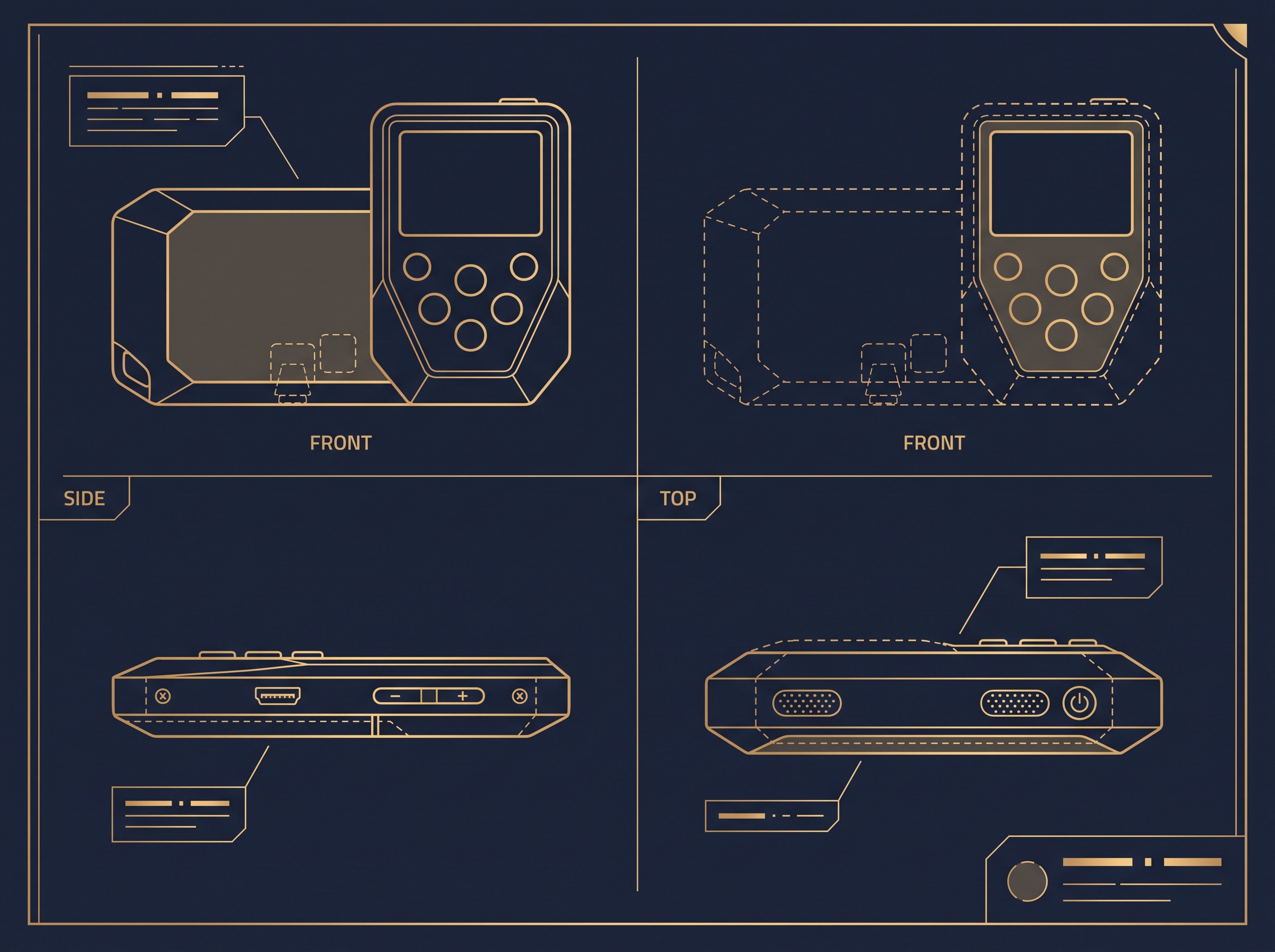
This is where strategy lives. Draw the entire product in solid lines and you protect that exact appearance — but a competitor who changes one visible detail may slip past it. Draw only the distinctive portion in solid lines and dash out the rest, and you protect that signature element across many variations. Getting this right is the main reason even budget-conscious inventors often pay a professional to prepare design drawings: a weak set of drawings produces a weak patent, no matter how good the underlying design is.
How to file, step by step
The process is more approachable than most people expect:
1. Search first. Check whether your design — or something confusingly close — already exists. Use free tools like the USPTO’s Patent Public Search and Google Patents, and also look at real products on the market, since any public product is prior art.
2. Prepare the drawings. This is 90% of the work. You’ll typically need multiple views (front, rear, both sides, top, bottom, and often a perspective view) so the full three-dimensional appearance is clear. Consistency across views matters; an inconsistency can get the application rejected.
3. File the application with the USPTO. A design application is short: the drawings, a single claim, a brief description, and the standard forms. You can file online. Claim small-entity or micro-entity status if you qualify (most individual creators and tiny businesses do) to cut the government fees substantially.
4. Respond to the examiner. A design examiner reviews it and may issue an “office action” raising objections — often about the drawings. You (or your attorney) respond, and in many cases the design is then allowed.
5. Pay the issue fee. Once allowed, you pay an issue fee and the patent grants. Notably, design patents have no maintenance fees — unlike utility patents, you never pay again to keep it alive.
Cost, timeline, and how long it lasts
This is where design patents shine for creators. Government filing, search, examination, and issue fees for a small or micro entity typically run a few hundred dollars total. Add professional drawings and some attorney help and many people get through the whole process for somewhere in the low-thousands range — a fraction of the five-figure cost that’s common for utility patents.
They’re also faster. Design applications generally move through examination quicker than utility applications, with many granting in roughly a year to two rather than the multi-year slog utility patents can become. And a U.S. design patent granted on an application filed on or after May 13, 2015 lasts 15 years from the date it’s granted, with nothing more to pay along the way.
Design patent vs. trade dress vs. copyright
A design patent isn’t the only way to protect how a product looks, and the smart move is often to stack it with others:
- Trade dress (a form of trademark) can protect a product’s look that has become associated with your brand in consumers’ minds. It can last forever as long as you use it — but you usually have to prove the look has acquired that brand recognition, which takes time. A design patent needs no such proof and can be obtained right away, but it expires. Many businesses use a design patent for the early years and build toward trade dress for the long haul.
- Copyright can protect artistic elements of a design that are separable from the product’s useful function — a decorative pattern or sculptural element, for instance. It’s free and automatic, but it won’t cover the overall shape of a useful article the way a design patent does.
These aren’t either/or choices. A single product can carry a design patent on its shape, trade dress on its signature look, and copyright on a decorative graphic, each covering a different angle.
Enforcing it: the “ordinary observer” test
A patent you can’t enforce is just a wall decoration, so it’s worth knowing how design-patent infringement is judged. The standard is the ordinary observer test: would an ordinary person, giving the attention a normal buyer would, think the accused product’s design is substantially the same as your patented one — enough that they might buy one thinking it was the other?

This is a powerful, common-sense standard. A knockoff artist can’t escape just by changing some tiny internal or hidden detail; what matters is the overall visual impression to a regular buyer. Design patents have real teeth here — the long-running Apple v. Samsung smartphone battle, which turned partly on design patents for things like rounded corners and the icon grid, is the famous proof that these aren’t toothless. For a creator fighting a cheap copycat on a marketplace, a granted design patent is often a faster, clearer takedown weapon than trying to argue the fuzzy boundaries of trade dress or copyright.
What this means for you — and your next steps
If your product’s edge is visual, a design patent probably belongs in your toolkit. Here’s the practical playbook:
- File before you go public. Your own launch can become prior art — immediately in most of the world, and after one year in the U.S.
- Invest in the drawings. They are the patent. Thoughtful use of solid vs. dashed lines decides how broad your protection is.
- Claim small- or micro-entity status if you qualify, and remember there are no maintenance fees — the cost is front-loaded and modest.
- Stack your protection. Pair a design patent with trade dress and copyright so each covers a different part of your product’s identity.
- Think internationally early if you’ll sell abroad — the Hague Agreement lets you file for design protection in many countries through a single application.
This article is general information, not legal advice. Whether your specific design qualifies, and how to draw the claims to get the broadest defensible protection, are judgment calls that depend on the details — so if there’s real money riding on your product’s look, it’s worth a conversation with a qualified patent attorney before you file or before you launch.
IPSurge helps creators and small businesses understand and protect their intellectual property — the ideas, names, and work that make them unique.
Sources & further reading:
- Design Patent Application Guide — USPTO
- 35 U.S.C. 171 — Patents for designs
- USPTO Fee Schedule
- Hague Agreement — International Design System (WIPO)