You spent six months building it. You scripted the lessons, recorded the videos, designed the workbook, tested the whole thing on your first cohort. Then one morning you find your entire course — your videos, your slides, your voice — repackaged on a sketchy website for nine dollars, or quietly handed around in a private group chat. It’s a gut punch, and it’s more common than most creators realize.
Here’s the good news and the uncomfortable news in one breath: intellectual property law gives you real tools to protect a course, but it doesn’t protect everything you might assume, and it won’t lift a finger on its own. Knowing exactly what you own — and what you don’t — is the difference between shutting a copycat down in an afternoon and spinning your wheels for weeks. Let’s make it clear.

What You Can Protect — and What You Can’t
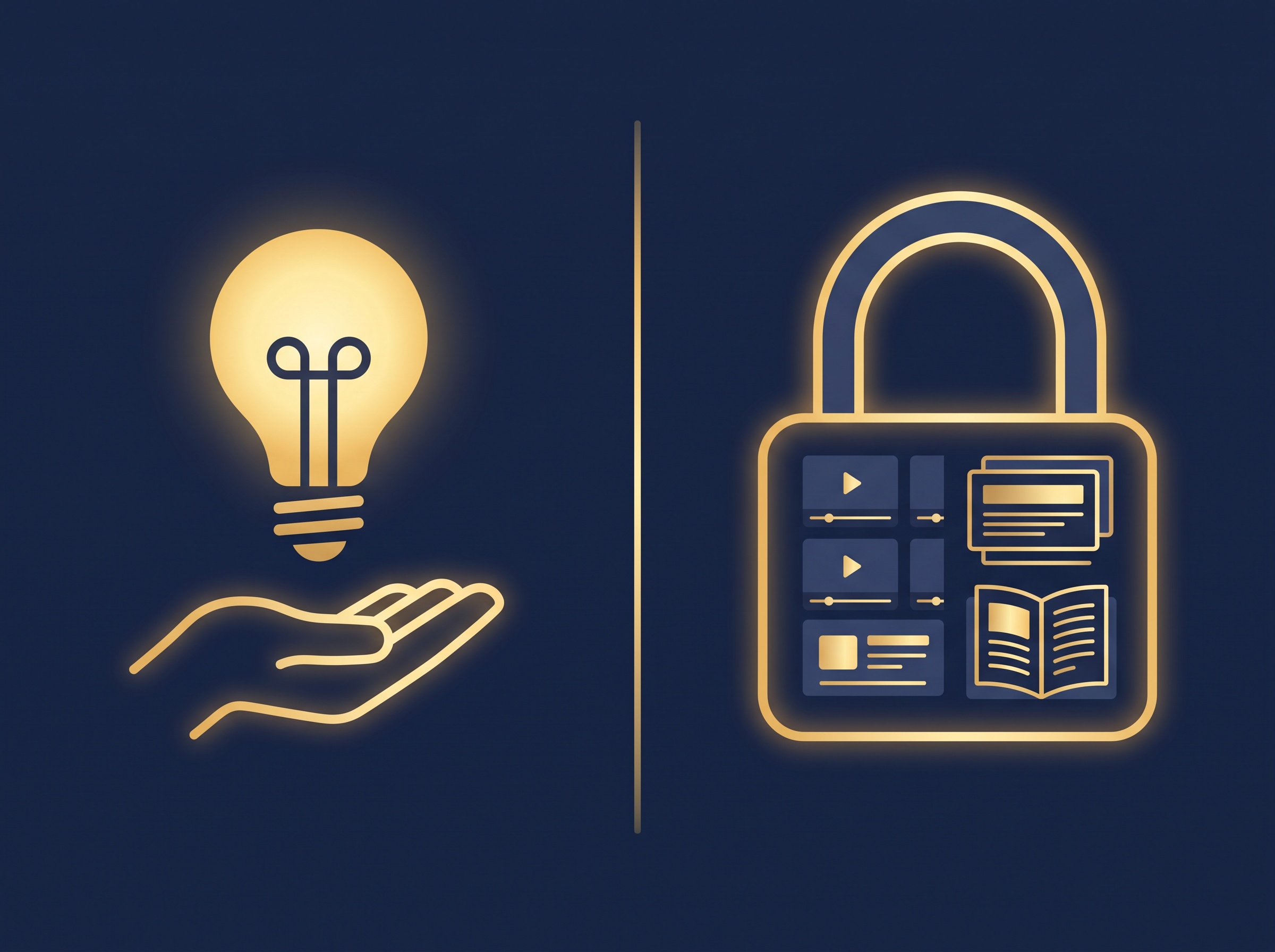
The single most important idea in course protection is this: copyright protects your specific expression, not the underlying idea, method, or system you teach. You cannot own “how to grow on Instagram” or “a five-step framework for better sleep” as a concept. Facts, procedures, methods, and general know-how are free for anyone to use — that’s the law working as intended, and it’s why a dozen people can all sell courses on the same topic.
Track the cases yourself
Every current AI-copyright ruling — and the ones still being fought — lives in our AI Copyright Ruling Tracker. Filter by your creator type to see, in plain language, how each case affects your rights.
What you do own is the way you expressed it: the actual words in your video scripts, the exact wording and layout of your slides, your workbook text and worksheets, your recorded lessons, your diagrams, your downloadable templates. If a competitor teaches the same five steps in their own words and their own videos, that’s fair game. If they rip your video files, copy your slides verbatim, or reproduce your workbook, that’s infringement. The line isn’t “same topic” — it’s “same expression.”
This distinction is freeing once it clicks. You stop wasting energy trying to police an idea you can’t own, and you focus your protection on the concrete, copyable assets you actually do.
Copyright: Your Strongest, Automatic Tool
Every original lesson you record and every workbook you write is protected by copyright the moment it’s created — no registration, no copyright symbol, nothing extra required. The second you hit “stop recording,” you own that video. That’s your baseline, and it already makes most copying illegal.
But automatic copyright is a quiet right, and quiet rights are hard to enforce. This is where registration earns its keep. Registering your course materials with the U.S. Copyright Office before (or shortly after) an infringement unlocks two things you can’t get otherwise: the ability to actually file a lawsuit for a U.S. work, and eligibility for statutory damages and attorney’s fees — potentially substantial sums a court can award without you having to prove exact lost revenue. That eligibility is enormous leverage. A copycat who might shrug off a polite email tends to take notice when the demand letter can credibly reference statutory damages.
Practical move: register your core materials as a batch — think of the course as a collection of works — rather than paying to register every tiny file separately. And keep your receipts of authorship: project files, draft dates, upload timestamps. Proving you made it first is rarely hard for a course, but documentation makes it effortless.
Trademark: Protect the Name, Not Just the Lessons
Copyright guards the contents of your course. It does nothing for your brand — and for a lot of creators, the brand is the business. Your course name, your signature framework’s name, your logo, and your tagline are the things students search for and trust. That’s trademark territory.
A trademark protects the names and symbols that identify the source of your product in the marketplace. If someone launches “a knockoff with a confusingly similar name to yours,” riding your reputation to sell their own stuff, trademark is the tool that stops them — copyright can’t, because they didn’t copy your actual content, just your brand. You get some rights automatically just by using a name in commerce (common-law rights), but federal registration with the USPTO gives you nationwide protection, a public record that deters copycats, and far stronger footing to force a name change or a platform takedown. If your course name is your reputation, registering it is one of the highest-leverage protective moves you can make.
Contracts and Terms: The Fence Around Your Course
IP law handles outright copiers. But a huge share of “theft” isn’t a stranger pirating your files — it’s a paying student who shares their login, downloads everything, or quietly passes the materials to five friends. For that, your best tool isn’t copyright law at all. It’s the terms every buyer agrees to.
Your checkout terms, student agreement, or license should spell out, in plain language, what a student is and isn’t allowed to do: this is a single-user license for personal use; no sharing accounts or passwords; no redistributing, reselling, or reposting the materials; no reproducing the workbooks for a group. When those terms are clearly presented and agreed to at purchase, a violator isn’t just infringing your copyright — they’re breaching a contract, which gives you an extra, often simpler, basis to act (including revoking access and pursuing chargeback-style remedies).
Pair the paperwork with friction that quietly discourages copying:
- Drip the content so the whole course isn’t downloadable in one sitting.
- Host video on a platform (rather than offering raw downloads) so you control access and can cut it off.
- Personalize materials — a subtle watermark or the buyer’s name on PDFs makes leaked copies traceable and makes people think twice.
- Limit concurrent logins to curb password-sharing.
None of this is bulletproof, and it shouldn’t be so aggressive it punishes honest students. The goal is to make casual copying inconvenient and deliberate piracy risky.
When Someone Copies You: The Takedown Playbook
So you found your course on someone else’s site or a file-sharing page. Here’s the escalation ladder, cheapest and fastest first.
1. Send a DMCA takedown notice. This is the workhorse. Under U.S. law, online platforms and web hosts that want legal safe harbor must remove infringing material when they get a proper notice from the copyright owner. Nearly every host, marketplace, and course platform has a copyright or DMCA contact. A valid notice is simple: identify yourself as the owner, identify your original work, point to the exact infringing URL, state a good-faith belief that the use isn’t authorized, and sign it. Many stolen copies vanish within days of a clean notice — no lawyer required.
2. Go to the platform’s IP tools. Marketplaces like Udemy, and hosts like Teachable or Kajabi, have dedicated infringement-reporting and brand-protection channels. Use them; they’re often faster than a generic complaint.
3. Send a cease-and-desist. If the copier is a person or business you can identify, a firm letter demanding they stop — referencing your registration and, where it applies, statutory damages — often ends it without court.
4. Escalate to legal action. Reserved for serious, high-value, or repeat infringement. This is where that early copyright registration pays off, because it’s what makes a lawsuit and statutory damages available in the first place.
A word of caution: only file takedowns against material that genuinely copies your expression. Firing a DMCA notice at a competitor who merely teaches the same topic in their own words is both wrong and legally risky — bad-faith notices can backfire on you.

What This Means for You
Protecting a course isn’t one dramatic move; it’s a stack of sensible ones. Start before you ever hit a problem: register the copyright in your core materials so you have real teeth, trademark your course or brand name if your reputation is the draw, and put clear single-user license terms in front of every buyer. Then build in light friction — dripped content, hosted (not downloadable) video, watermarked PDFs — so copying is more trouble than it’s worth. And keep a simple DMCA notice template ready, because the day you need it, speed matters.
Remember the boundary that saves you the most grief: you can’t own the idea, only your expression of it. Spend zero energy chasing people who teach your topic, and all your energy protecting the specific videos, slides, and workbooks that are unmistakably yours. Do that, and the next person who tries to resell your work for nine dollars becomes a quick takedown notice — not a six-month headache.
This article is general information, not legal advice. Copyright registration, trademark eligibility, DMCA procedure, and contract enforcement turn on your specific facts and jurisdiction, and the details matter. Before you register, send formal notices, or pursue a copycat, consider having a qualified IP attorney review your situation.
IPSurge helps creators, developers, and small businesses understand and protect their intellectual property — the names, work, and ideas that make them unique.
Sources & further reading:
- What Is Copyright? — U.S. Copyright Office
- Copyright Basics (Circular 1) — U.S. Copyright Office
- What Does Copyright Protect? (FAQ) — U.S. Copyright Office
- Section 512 of Title 17 (DMCA Safe Harbor / Takedowns) — U.S. Copyright Office
- Trademark Basics — U.S. Patent and Trademark Office