You built the thing. Weeks of late nights, a repo full of your own logic, and an app that finally works. Then the nagging question shows up: is any of this actually yours in a way the law will back up? Can you even copyright code — and if a competitor rips it off, could you do anything about it?
The short answer is reassuring: yes, software is protected by copyright, and it happens automatically. The longer answer is where solo developers get tripped up — because automatic protection is real but weak on its own, copyright doesn’t cover the parts you might assume it does, and a couple of cheap steps make the difference between a right you can enforce and one that just looks good on paper. Here’s the plain-language version, developer to developer.

Yes — Code Is Copyrighted the Moment You Write It
Copyright law treats a computer program as a “literary work.” That’s a slightly funny label, but the effect is powerful: your source code is protected the instant it’s fixed in a tangible form — the moment you save the file. You don’t have to register it, publish it, add a © notice, or file anything to own the copyright. If you wrote it and it’s original (which nearly all real code is), you’re the author and the copyright is yours.
Track the cases yourself
Every current AI-copyright ruling — and the ones still being fought — lives in our AI Copyright Ruling Tracker. Filter by your creator type to see, in plain language, how each case affects your rights.
Both your source code and the compiled object code are covered. So are things like your original documentation, and in many cases the distinctive parts of your app’s screens. Ownership is the easy part.
The catch is enforcement. Automatic copyright gives you a right, but on its own it’s hard to use. You can’t file a U.S. infringement lawsuit until the work is registered, and if you register late you lose access to the most powerful remedies. So “I automatically own it” and “I can actually stop someone and get paid” are two very different levels of protection — and the gap between them is the whole point of this article.
What Copyright Actually Covers in Your Code (and What It Doesn’t)
This is the single most misunderstood thing about software copyright, so it’s worth being precise. Copyright protects the specific expression — the actual lines you wrote, in the order and structure you wrote them. It does not protect the underlying idea, the method, the algorithm, or the functionality. This is the famous idea–expression dichotomy, and for code it’s written right into the law (17 U.S.C. § 102(b) excludes any “procedure, process, system, method of operation” from copyright).
In practice that means:
- Protected: your literal code, copied verbatim or near-verbatim. If someone lifts your source and reuses it, that’s textbook infringement.
- Protected (sometimes): non-literal elements like the structure, sequence, and organization of a program — but only to the extent they reflect creative choices rather than pure function.
- Not protected: the idea behind the app, the general approach, the algorithm as a concept, or the feature set. A competitor is free to build a program that does exactly what yours does — as long as they write their own code to do it.
This is why the Supreme Court’s decision in Google v. Oracle (2021) mattered so much: the Court treated Google’s reuse of certain Java API declarations as fair use, underscoring that the functional, interoperability-driven parts of software get thin copyright protection at best. The takeaway for you: copyright is a strong shield against someone copying your code, and a weak one against someone rebuilding your idea.
Copyright vs. Patent vs. Trade Secret: Which One Protects Software?
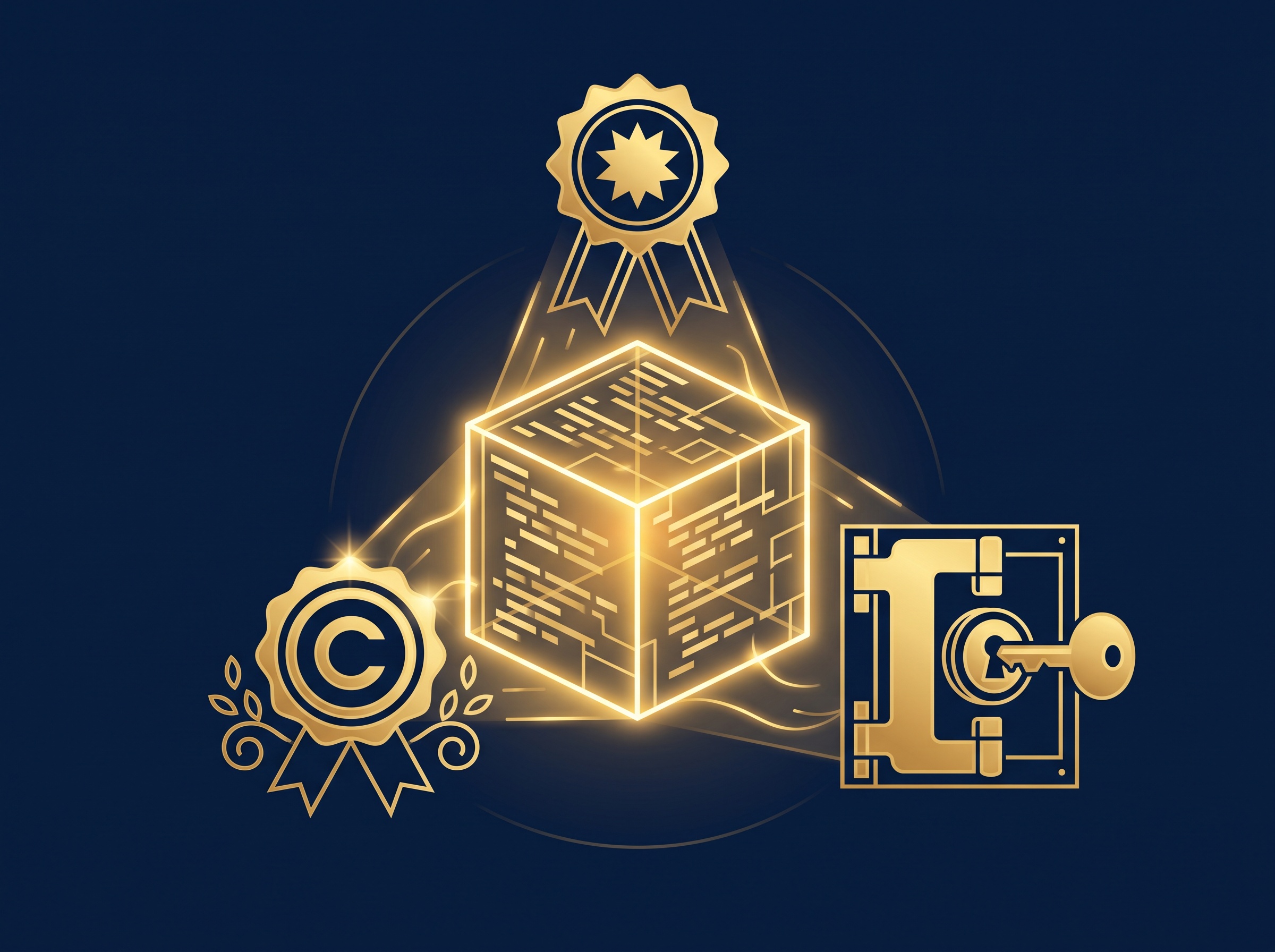
Because copyright only guards the written expression, developers often need a second tool to protect the parts copyright leaves exposed. There are three, and they do different jobs.
Copyright protects the code as written. It’s automatic, free, lasts for decades, and is your everyday defense against literal copying. For most solo developers, it’s the workhorse.
Patents can protect a genuinely novel, non-obvious invention implemented in software — the method or process itself, which copyright can’t touch. But software patents are expensive (often five figures), slow (years), hard to get, and easy to design around. For the overwhelming majority of indie apps, a patent isn’t worth it. It only makes sense when you’ve invented something truly new at the technical level and it’s central to your business.
Trade secrets protect anything valuable because it’s secret — your unpublished source code, a proprietary algorithm, internal architecture. Protection lasts as long as you keep it confidential (think NDAs, access controls, the classic Coca-Cola-recipe approach). The moment it leaks or you publish it, the trade secret is gone. This is often the best fit for server-side code and algorithms you never ship to users.
These aren’t either/or. A typical setup: copyright on all your code by default, trade-secret practices around the source you keep private, and a patent only if you’ve built something genuinely inventive and can afford to protect it.
Should You Register Your Copyright? (For U.S. Devs, Usually Yes)
You own the copyright automatically — so why pay to register it? Because in the United States, registration is what unlocks real enforcement, and it’s cheap.
- You can’t sue without it. A U.S. copyright owner generally must register (and have the registration processed) before filing an infringement suit. No registration, no lawsuit.
- Statutory damages and attorney’s fees. This is the big one. If you register before the infringement (or within three months of first publication), you become eligible for statutory damages — up to $150,000 per work for willful infringement — plus your attorney’s fees. Without timely registration, you’re limited to proving actual damages, which for software is often small and hard to quantify. Statutory damages are what make an infringer actually fear you.
- A public record and presumption of validity. A registration made within five years of publication is presumptive evidence that your copyright is valid and you’re the owner — a real head start if you ever have to prove it.
Registration currently costs on the order of tens of dollars for a single-author online filing. For a serious project, that’s one of the highest-leverage legal dollars a developer can spend. There’s also a lighter-weight option worth knowing about: the Copyright Claims Board (CCB), a tribunal for smaller disputes (damages capped at $30,000) that’s far cheaper and less formal than federal court — useful for solo devs who can’t justify a full lawsuit.
How to Register Software Copyright — Without Handing Over Your Secrets
You can do this yourself through the Copyright Office’s online system (eCO). The basic flow:
- Pick the right application for a computer program and identify yourself as the author/claimant (register the code as your work; if a company owns it, the company is the claimant).
- Pay the fee and complete the form — author, title, year of creation, whether it’s published.
- Submit a deposit copy. Here’s the part developers worry about: you generally deposit identifying portions of the source code — typically the first and last 25 pages — not the entire codebase.
- Protect your secrets in the deposit. The Office has special procedures that let you redact or block out trade-secret material in the deposited pages (or deposit object code) so registering doesn’t force you to publish your crown-jewel algorithms. Use them if your source contains anything you keep confidential.
One practical note: software changes constantly, and each registration covers a specific version. You don’t need to re-register every commit — register meaningful releases, and re-register a version if it’s substantially revised and worth protecting.

What This Means for You: Protecting Code as a Solo Developer
Pulling it together into a short, do-this checklist for indie devs:
- Know you already own it. Your original code is copyrighted automatically. You don’t need permission or a notice to hold the right — though adding a simple © notice and a
LICENSEfile signals your claim clearly. - Register the projects that matter. For anything commercial or worth defending, register early — ideally within three months of release — to keep statutory damages and attorney’s fees on the table. It’s cheap insurance.
- Make sure the code is actually yours. If a contractor, freelancer, or collaborator wrote any of it, copyright defaults to them, not you — “work made for hire” rules are narrow and often don’t apply to independent contractors. Get a written IP assignment in the contract so ownership lands with you. This is the single most common way solo founders discover they don’t own their own product.
- Mind your dependencies. Open-source components come with license conditions; complying with them keeps your right to ship intact. (Copyright is what makes those licenses enforceable in the first place.)
- Use trade-secret hygiene for private code. NDAs, access controls, and not publishing your server-side source keep the parts copyright can’t fully protect out of a competitor’s hands.
- If someone copies you, you have moves. A DMCA takedown for infringing code on a platform like GitHub, a cease-and-desist, the Copyright Claims Board for smaller amounts, or a full suit if the stakes justify it — but the strong options depend on having registered.
So — can you copyright code? Absolutely, and you already have, on everything original you’ve written. The real work isn’t getting the copyright; it’s understanding that it protects your expression rather than your idea, backing it up with a cheap registration so it has teeth, and making sure a contract puts ownership firmly in your name. Do those three things and your software is protected in a way you can actually stand behind.
This article is general information, not legal advice. Copyright rules for software — especially registration timing, deposit requirements, work-made-for-hire status, and the line between idea and expression — turn on specific facts, and details vary outside the United States. For decisions with real money or a genuine dispute on the line, review the Copyright Office’s guidance and consult a qualified intellectual-property attorney.
IPSurge helps creators, developers, and small businesses understand and protect their intellectual property — the code, work, and ideas that make them unique.
Sources & further reading:
- Copyright Registration of Computer Programs — U.S. Copyright Office (Circular 61)
- Copyright Basics — U.S. Copyright Office (Circular 1)
- 17 U.S. Code § 102 — Subject matter of copyright
- Google LLC v. Oracle America, Inc. — U.S. Supreme Court (2021)
- Copyright Claims Board — copyright.gov