You built an app, designed a clever algorithm, or dreamed up a smarter way to run a business, and now you’re wondering: can I actually patent this? The honest answer is the most frustrating one in all of intellectual property — sometimes. Software, algorithms, and business methods live in a strange, contested corner of patent law where two nearly identical ideas can get opposite answers, and the difference usually isn’t what you’d guess.
The good news is that there’s essentially one rule that decides almost every case. Once you understand it, the whole confusing landscape snaps into focus. Let’s walk through it in plain language, then look at where the law actually stands in 2026.
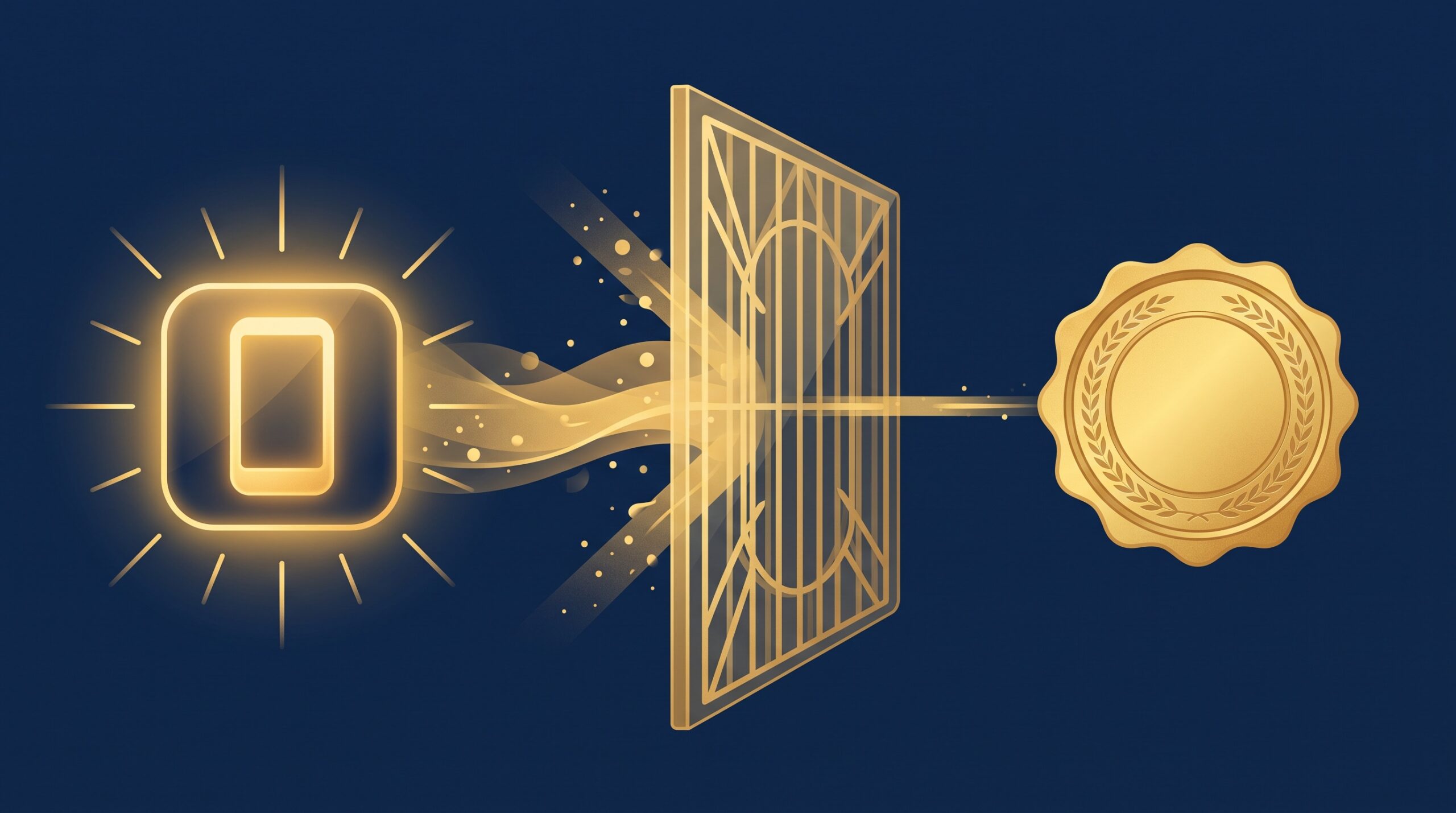
The short answer: it depends on how, not what
There is no rule that says “software can’t be patented” or “business methods are off-limits.” Thousands of software and app patents get granted every year. What the law actually says is that you cannot patent an abstract idea — and the problem is that a huge amount of software, when you strip it down, looks like an abstract idea dressed up in technical clothing.
Track the cases yourself
Every current AI-copyright ruling — and the ones still being fought — lives in our AI Copyright Ruling Tracker. Filter by your creator type to see, in plain language, how each case affects your rights.
So the real question is never “is my app patentable?” in the abstract. It’s: “Is my invention a specific, concrete way of doing something new — or is it just an idea that happens to run on a computer?” The first can be patented. The second almost never can, no matter how valuable it is.
The one rule that decides everything: no patents on abstract ideas
U.S. patent law (Section 101) says you can patent a new and useful “process, machine, manufacture, or composition of matter.” That sounds broad, and it is. But courts have carved out three things you can never patent, no matter what: laws of nature, natural phenomena, and abstract ideas.
That last one is the killer for software. A mathematical formula is an abstract idea. A fundamental economic practice — like hedging risk, or holding money in escrow until both sides deliver — is an abstract idea. A method of organizing human activity that could just as easily be done with pen and paper is, courts say, an abstract idea. And taking any of those and saying “…but on a computer” or “…over the internet” does not magically make it patentable.

This is the heart of the landmark 2014 Supreme Court decision, Alice Corp. v. CLS Bank. Alice had patents on using a computer to manage settlement risk between two parties. The Court said: that’s just the age-old idea of escrow, and running it on a generic computer adds nothing inventive. The patents were invalid. That single ruling reshaped software patenting overnight and still governs in 2026.
The two-step test, in plain English
After Alice, examiners and courts run every software or business-method claim through a two-step test (the Alice/Mayo framework). You can run your own idea through it right now:
Step one: Is the claim “directed to” an abstract idea — a mathematical concept, a method of organizing human activity, or a basic mental process? If no, you’re fine, and your invention is eligible. If yes, you move to step two.
Step two: Does the claim add an “inventive concept” — something that amounts to significantly more than the abstract idea itself? Generic computer components doing generic computer things (storing data, performing calculations, sending it over a network) are not significantly more. But a specific, unconventional technical solution can be.

In other words: identifying an abstract idea at step one isn’t a death sentence. The question becomes whether you’ve invented a genuine, concrete improvement in how the thing works — not just a new use for an old idea.
Algorithms and business methods: the hardest cases
Pure algorithms are the clearest losers. A mathematical algorithm, claimed on its own, is textbook abstract — it’s just applied math. You cannot own a formula. But an algorithm that produces a specific technical improvement — one that makes a computer itself work better, compresses data more efficiently, improves how a network routes traffic, or solves a concrete engineering problem in a non-obvious way — can cross the line into eligible territory. The algorithm isn’t patented in the abstract; the improved machine or process is.
Business methods are the other hard case, and history matters here. In the 2010 decision Bilski v. Kappos, the Supreme Court rejected a patent on a method of hedging commodity-trading risk. Business methods aren’t categorically banned — the Court declined to say that — but after Bilski and then Alice, a method that’s really just “a way of doing business,” even a brilliant one, is extraordinarily hard to patent. If your innovation is a pricing model, a marketplace structure, or a clever workflow, patent law is probably not your tool. (Trade secrets, trademarks, and copyright often protect the real value instead.)
What actually gets patented: the technical-improvement trick
Here’s the pattern that separates granted software patents from rejected ones. The winners don’t claim the idea; they claim a specific technical solution to a technical problem.
Think of it as the difference between these two:
- “A method of recommending products to users based on their behavior” — abstract, almost certainly rejected.
- “A specific data structure and processing technique that lets a device generate those recommendations using a fraction of the memory and without a round-trip to the server” — now you’re describing a concrete improvement in how the computer operates, which has a real shot.
This is why how you describe your invention matters enormously. Two inventors with the same app can get opposite results purely based on whether their patent application frames the invention as an abstract goal or as a concrete, non-obvious technical mechanism. This is also where an experienced patent attorney earns their fee — drafting claims that survive step two is a genuine craft, not a form-filling exercise.
Where the law stands in 2026 — and why it might change
As of late 2026, Alice still rules. Software and business-method eligibility looks much as it has for the past decade: unpredictable at the edges, with similar inventions sometimes drawing opposite rulings. Critics — including some federal judges — argue the test is too vague and has made the U.S. a harder place to patent software than Europe or China.
Congress has been trying to fix it. The Patent Eligibility Restoration Act (PERA) of 2025 — S.1546 in the Senate (Sen. Tillis) and H.R.3152 in the House (Rep. Kiley) — would rewrite Section 101 to narrow the judge-made exceptions and spell out exactly what’s ineligible (like a pure mathematical formula, or a mental process done entirely in your head), while cutting back on the “it’s abstract” rejections that sweep in real technical inventions. It would keep guardrails against patenting something just by bolting on a generic computer.
But PERA is not law. As of October 2026 it remains in committee; the Senate Judiciary Committee held a hearing on it in July 2026, but it has not been marked up, voted on, or passed by either chamber — the fourth attempt at this kind of reform in recent years. Until something actually passes and is signed, Alice is the law, and you should plan around the test as it exists today, not the one that might arrive.
What this means for you
If you’re a founder, developer, or creator weighing whether to patent software, here’s the practical takeaway:
- “Can I patent it?” is really “is there a concrete technical improvement here?” If your innovation makes a machine or process work in a new, better, non-obvious way, you may have an eligible invention. If it’s a great idea that simply runs on ordinary computers, patent law probably can’t protect it.
- Pure algorithms and pure business methods are the longest shots. Don’t build your strategy around patenting the math or the business model itself.
- How you frame it changes the outcome. This is the single biggest reason to involve a patent professional before you file — the difference between “abstract idea” and “technical improvement” often lives in the drafting.
- Watch PERA, but don’t bet on it. Reform could loosen these rules; it also could stall again, as it has before.
- Patents aren’t the only lock. Copyright protects your code, trade secrets protect your methods, and trademarks protect your brand — often a better fit for software than a patent that may not survive.
This article is general information, not legal advice. Software eligibility is one of the most unpredictable areas of patent law, and the right answer for your specific invention really does depend on the details — so if there’s real value on the line, it’s worth a conversation with a qualified patent attorney before you spend money filing.
IPSurge helps creators and small businesses understand and protect their intellectual property — the ideas, names, and work that make them unique.
Sources & further reading:
- Alice Corp. v. CLS Bank International (2014) — U.S. Supreme Court
- Patent subject matter eligibility (MPEP 2106) — USPTO
- Bilski v. Kappos (2010) — U.S. Supreme Court
- S.1546 — Patent Eligibility Restoration Act of 2025 (119th Congress)
- General information concerning patents — USPTO