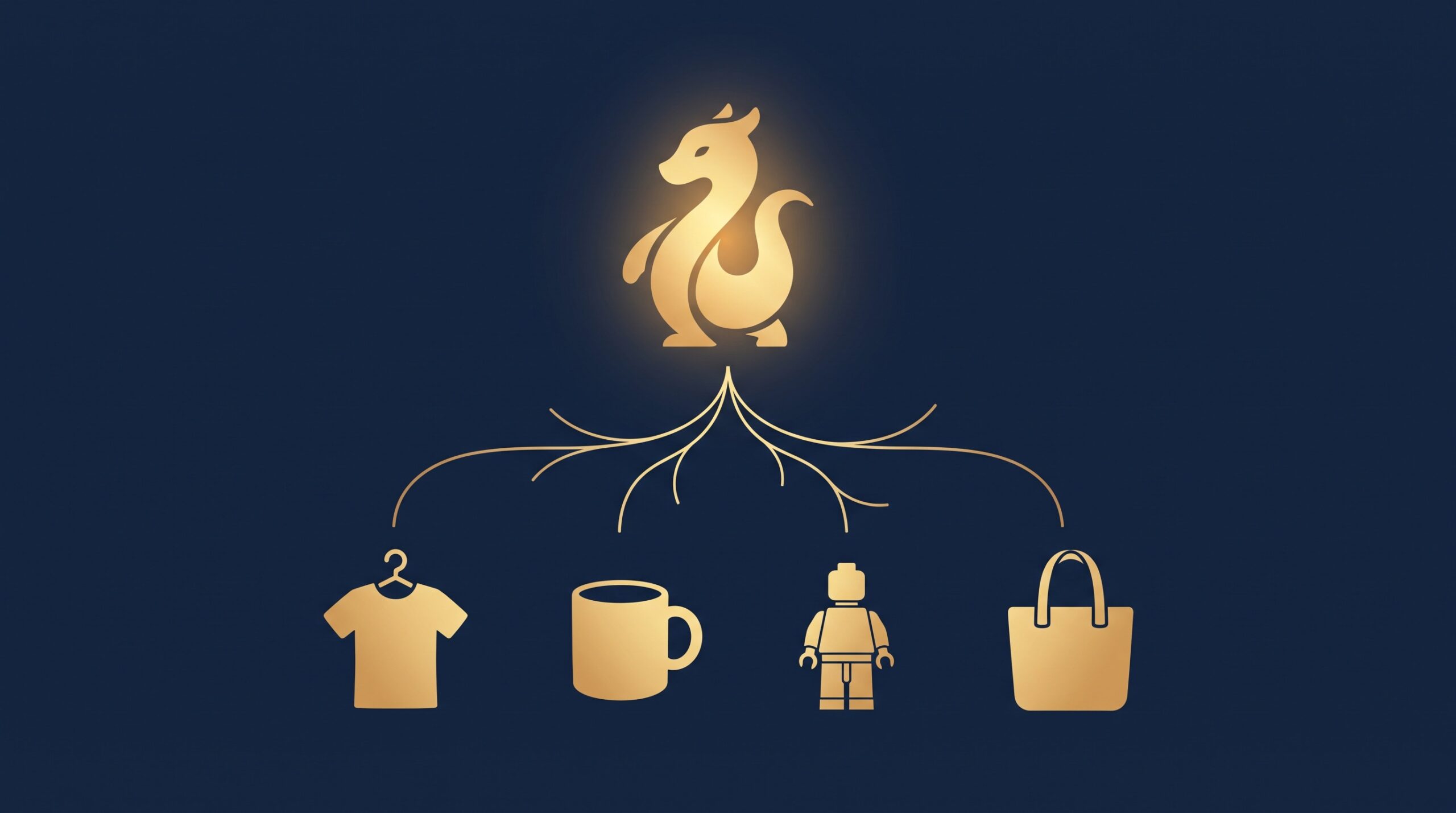
You created a character people adore — a mascot, a comic hero, a recognizable art style, a little illustrated creature that shows up in every comment section. Sooner or later someone asks the magic question: can I get that on a T-shirt? The grown-up version of that question is a merchandising deal: you let a company turn your creation into physical products — apparel, toys, mugs, phone cases, enamel pins — and they pay you for the privilege. You don’t manufacture anything. You don’t ship boxes. You license what you already own and collect a cut.
Done right, it’s one of the cleanest ways for a creator to earn real money from a single idea. Done carelessly, you can sign away control of your own character for years and barely see a dollar. Here’s how merch licensing actually works, in plain language, so you can tell a good deal from a trap.
What a Merchandising Deal Actually Is
A merchandising deal is a license — you are renting out specific rights, not selling your creation. You stay the owner. The company (the licensee) gets permission to reproduce your character or art on an agreed set of products, make and sell them, and in exchange pays you money, usually as a percentage of sales.
Track the cases yourself
Every current AI-copyright ruling — and the ones still being fought — lives in our AI Copyright Ruling Tracker. Filter by your creator type to see, in plain language, how each case affects your rights.
That distinction matters enormously. In a license, the asset is still yours; when the deal ends, the rights come home to you. The opposite would be an assignment — permanently transferring ownership — which is almost never what you want for a character you intend to keep building a brand around. If a contract says you “assign” or “transfer all rights” rather than “grant a license,” stop and get advice. Those are completely different outcomes.
First, Make Sure You Own What You’re Licensing
You can only license what you actually own, so before anyone talks royalties, nail down your rights. A merchandisable character is usually protected by two kinds of IP working together:
- Copyright covers the creative expression — the drawing, the design, the specific look of your character. It exists automatically the moment you create the work, but registering it with the U.S. Copyright Office gives you far stronger enforcement options and is worth doing before a deal, not after.
- Trademark covers the name and branding — the character’s name, your logo, a catchphrase — when they identify you as the source of goods. If people will buy a product because it carries your character’s name, that name is functioning as a trademark, and registering it protects it.
There’s a trap here too: if other people helped create the character — a collaborator, a freelancer you hired, an artist who refined your sketch — they may co-own the copyright unless you have a written agreement saying otherwise. You cannot cleanly license something you only partly own. Sort out clear, documented ownership first; a licensee’s lawyers will ask you to promise (and legally guarantee) that the rights are yours to grant.

The Money: Royalties, Advances, and Minimum Guarantees
This is the part everyone wants to understand, and it has three moving pieces.
- Royalty rate. Your ongoing cut, almost always a percentage of the licensee’s net sales (typically their wholesale revenue minus a few defined deductions). Rates vary widely by product category and your bargaining power — single digits are common for mass-produced goods, higher for premium or niche products. The crucial detail is the base: a percentage “of net wholesale sales” and a percentage “of retail” are very different numbers, so always pin down exactly what the percentage is calculated on.
- Advance. An upfront payment, paid when you sign, that is credited against (recouped from) your future royalties. It’s not extra money on top — it’s early money. But it’s real cash in hand, and it signals the licensee is serious.
- Guaranteed minimum royalty (the “minimum guarantee” or GMR). This is your safety net and arguably the most important term in the whole deal. It’s a floor: the licensee promises to pay you at least a set amount over the term whether or not products sell. Without a meaningful minimum, a company can lock up your character, do nothing with it, and you earn nothing while your rights sit frozen.
Read those together and the logic is clear: the advance gets you paid now, the royalty rate sets your upside, and the minimum guarantee protects you from a partner who sits on your IP.
The Deal Terms That Decide Everything
Beyond the money, four dials define how much you’re really giving up. Negotiate every one of them — narrow is almost always safer.
- Licensed products (scope). Exactly which products can they make? “Apparel” is not the same as “all consumer goods.” Grant only the categories this partner will actually produce well. Everything you don’t license stays available for you or for other deals.
- Territory. Where can they sell — one country, a region, worldwide? Don’t hand over global rights to a company that only sells domestically; you give up every other market for nothing.
- Term. How long does the deal run, and how does it renew? Favor a defined term (a few years) with renewal only if they’re hitting sales targets, rather than an open-ended grant.
- Exclusivity. Is this partner the only one allowed in their category and territory, or can you license the same products elsewhere? Exclusive deals command more commitment (and usually a bigger minimum guarantee) but shut every other door in that lane — so keep exclusivity as tight as the product category and region allow.
Keep Control: Approval Rights and Quality Control
Every product that ships carries your name and reputation. If a licensee makes something cheap, off-model, or offensive, your fans blame you, not them. So a good merchandising agreement gives you approval rights: the licensee must submit samples, artwork, and packaging for your sign-off before anything goes to market. Insist on this. It’s how you make sure your character looks right and the quality meets your standard.
Quality control isn’t just about pride — for trademarks, it’s a legal necessity. If you license your brand but exercise no real control over the quality of the goods, you risk what’s called a naked license, which can weaken or even forfeit your trademark rights. In other words, staying hands-on about quality is what keeps the very asset you’re licensing alive. Build in the right to review samples, require them to meet your standards, and keep the right to pull approval if they slip.
Red Flags and Protections to Negotiate For
A few more clauses separate a safe deal from a risky one. Watch for — and ask for — these:
- Reversion / termination for inactivity. If the licensee fails to launch products or misses the minimum guarantee, the rights should automatically come back to you. Never let your character be held hostage by a partner who stops performing.
- Audit rights. You’re paid on their sales figures, so you need the contractual right to inspect their records and verify the royalties are accurate. Trust, but verify.
- Approval over sublicensing. Can they hand your character off to other manufacturers? If sublicensing is allowed at all, it should require your written consent — otherwise you lose track of who’s making what.
- Indemnification and insurance. If a defective product harms someone, that’s the manufacturer’s liability, not yours. The agreement should say so, and require the licensee to carry product-liability insurance that also protects you.
- Sell-off period. When the term ends, how long can they keep selling leftover inventory? Keep it short and defined, so old product doesn’t linger in stores for years after the deal is over.
What This Means for You
A merchandising deal can turn a beloved character or art style into a genuine income stream without you ever touching a factory — but only if you treat the contract as seriously as the creation. Before you sign anything: secure your ownership (register the copyright, protect the name, and clear up any co-creator claims), then focus your negotiation on the terms that actually protect you — a real minimum guarantee, a narrow scope and territory, a defined term with performance-based renewal, firm approval and quality-control rights, and a reversion clause if the partner underperforms. Start with the smallest sensible grant: it’s far easier to license more categories later than to claw back rights you gave away too broadly on day one.
This article is general information, not legal advice. Licensing agreements are binding contracts with long-term consequences, royalty and ownership terms can be subtle, and the right structure depends on your specific situation. Before you sign or negotiate a merchandising deal, have a qualified IP or licensing attorney review it.
IPSurge helps creators, developers, and small businesses understand and protect their intellectual property — the names, work, and ideas that make them unique.
Sources & further reading:
- Copyright Basics (Circular 1) — U.S. Copyright Office
- Copyright in Derivative Works and Compilations (Circular 14) — U.S. Copyright Office
- Trademark basics — USPTO
- Keeping your registration alive / maintaining a trademark — USPTO
- License your product or service — U.S. Small Business Administration